The Sine & Cosine “Square Root” Trick
| Degrees | Radians | Sine | Cosine |
| 0 | 0 | \(\frac{\sqrt{0}}{2}=0\) | \(\frac{\sqrt{4}}{2}=1\) |
| 30 | \(\pi /6\) | \(\frac{\sqrt{1}}{2}=\frac{1}{2}\) | \(\frac{\sqrt{3}}{2}\) |
| 45 | \(\pi /4\) | \(\frac{\sqrt{2}}{2}=\frac{1}{\sqrt{2}}\) | \(\frac{\sqrt{2}}{2}=\frac{1}{\sqrt{2}}\) |
| 60 | \(\pi /3\) | \(\frac{\sqrt{3}}{2}\) | \(\frac{\sqrt{1}}{2}=\frac{1}{2}\) |
| 90 | \(\pi /2\) | \(\frac{\sqrt{4}}{2}=1\) | \(\frac{\sqrt{0}}{2}=0\) |
Fundamental Constants
- \(\pi \approx 3.1415926535\)
Mnemonic: “May(3) I(1) have(4) a(1) large(5) container(9) of(2) coffee(6) beans(5)?” - \(e \approx 2.718281828459045\)
Mnemonic: 2.7, followed by the year 1828 twice, then the angles of an isosceles right triangle (45, 90, 45).
Logarithm Cheat Sheet
- Product Rule: \(\log_b(xy) = \log_b x+\log_b y\)
- Quotient Rule: \(\log_b(x/y) = \log_b x-\log_b y\)
- Power Rule: \(\log_b(x^p) = p \log_b x\)
- Change of Base: \(\log_b x = \frac{\log_c x}{\log_c b}\)
The De Moivre Shortcut
To derive double angles without memorizing, use De Moivre’s Theorem for the case where \(n=2\):
\( (\cos \theta+i\sin \theta)^2=\cos(2\theta)+i\sin(2\theta)\)
The Expansion: Expanding the left side gives:
\(\cos^2 \theta+2i\sin \theta \cos \theta-\sin^2 \theta\)
The result: By Grouping the real and imaginary parts on both sides, we get the identities:
- Real (Cosine): \(\cos(2\theta)=\cos^2 \theta-\sin^2 \theta\)
- Imaginary (Sine): \(\sin(2\theta)=2 \sin\theta\cos \theta\)
The Empirical (Three-Sigma) Rule
In a normal distribution (Bell Curve), data is distributed around the mean (\(\mu\)) based on standard deviations (\(\sigma\)):
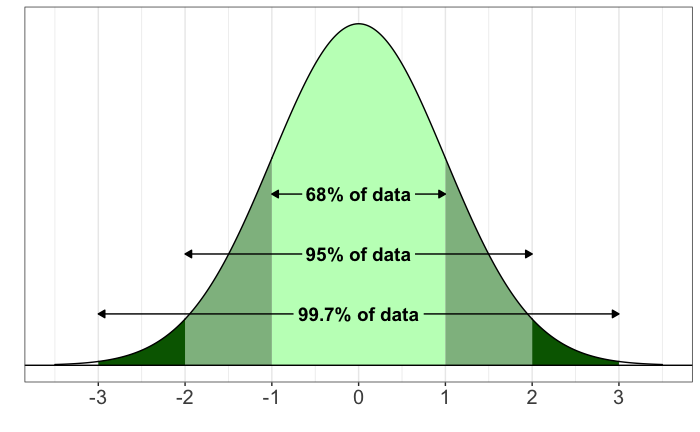
- \(\pm 1\sigma\): 68.2% of all outcomes.
- \(\pm 2\sigma\): 95.4% of all outcomes.
- \(\pm 3\sigma\): 99.7% of all outcomes.