Theorem
Gabriel’s Horn, the solid of revolution formed by rotating \(y = 1/x\) for \(x \geq 1\) around the \(x\)-axis, has finite volume but infinite surface area.
Introduction
Gabriel’s Horn — also known as Torricelli’s Trumpet — is one of the most surprising and beautiful objects in mathematics. It is formed by taking the curve \(y = 1/x\) for \(x \geq 1\) and rotating it around the \(x\)-axis, producing a shape that resembles an infinitely long trumpet, open at one end and narrowing forever toward the other.
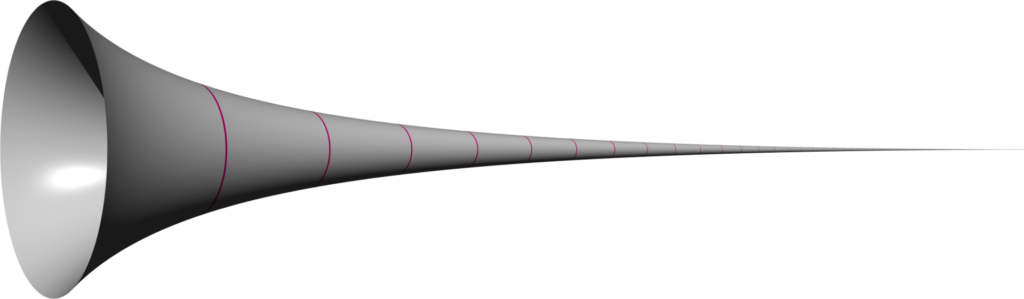
The object was first studied by the Italian mathematician and physicist Evangelista Torricelli in 1643 — remarkably, before the invention of calculus. Using a geometric method known as Cavalieri’s principle, Torricelli proved something that shocked the mathematical world of his day: this infinitely long solid encloses a finite volume. Today, calculus makes the result straightforward to verify, as we show below.
What makes Gabriel’s Horn truly extraordinary is not the finite volume alone, but the combination of two facts taken together:
- The volume of Gabriel’s Horn is finite — exactly \(\pi\) cubic units.
- The surface area of Gabriel’s Horn is infinite.
An object that extends forever, yet can be filled with a finite amount of paint — but cannot be painted. This is the paradox of Gabriel’s Horn, and it has fascinated mathematicians, philosophers, and students for nearly four centuries.
Volume
Surface Area
Since \(x\geq 1 > 0\),
Thus,
Evaluating the lower bound:
Since \(A\) is bounded below by a divergent integral, the surface area of Gabriel’s Horn is infinite.
Conclusion: The Paradox and Its Resolution
The result we have just established — finite volume, infinite surface area — was described by Torricelli himself as “paradoxical,” and it provoked genuine controversy among the leading thinkers of the 17th century. Philosophers such as Thomas Hobbes argued that mathematics could not be trusted if it led to such intuitively absurd conclusions. Even today, after a first encounter with the result, most people feel that something must be wrong.
The most vivid way to state the paradox is this: you could fill Gabriel’s Horn with exactly \(\pi\) cubic units of paint, but no finite amount of paint could ever coat its interior surface. It seems to take more paint to fill a paint can than to paint it — yet for Gabriel’s Horn, the situation is reversed, and by an infinite margin.
How do we make sense of this?
The first step is to recognize that volume and surface area are not in competition with each other. They measure fundamentally different things — volume measures three-dimensional space, surface area measures two-dimensional extent — and one being finite places no constraint on the other. A flat sheet of paper has surface area but essentially no volume. Gabriel’s Horn’s surface is, in essence, an infinitely long two-dimensional sheet rolled into a tube. That sheet contributes almost nothing to the volume — which is why the volume is finite — but the sheet itself is infinite in extent.
The second step is to think carefully about what happens deep inside the horn. As you travel further down toward infinity, the radius of the horn shrinks toward zero. At some point the tube becomes so narrow that no paint of any positive thickness can fit inside it. The volume “runs out” of room. But the surface has zero thickness — it does not need room. It simply keeps going, forever narrowing but never disappearing, contributing to an infinite total extent.
This is the resolution of the paradox. Filling the horn requires occupying three-dimensional space, and the space shrinks fast enough to remain finite. Coating the surface requires covering a two-dimensional sheet, and that sheet — having no thickness — keeps going regardless of how narrow the tube becomes.
Gabriel’s Horn is a reminder that infinity does not behave the way our intuition expects. An infinite object can have a finite size. A surface can be too large to paint but enclose a space too small to notice. Mathematics, as Torricelli showed nearly four centuries ago, is capable of surprising even the most careful thinker.